
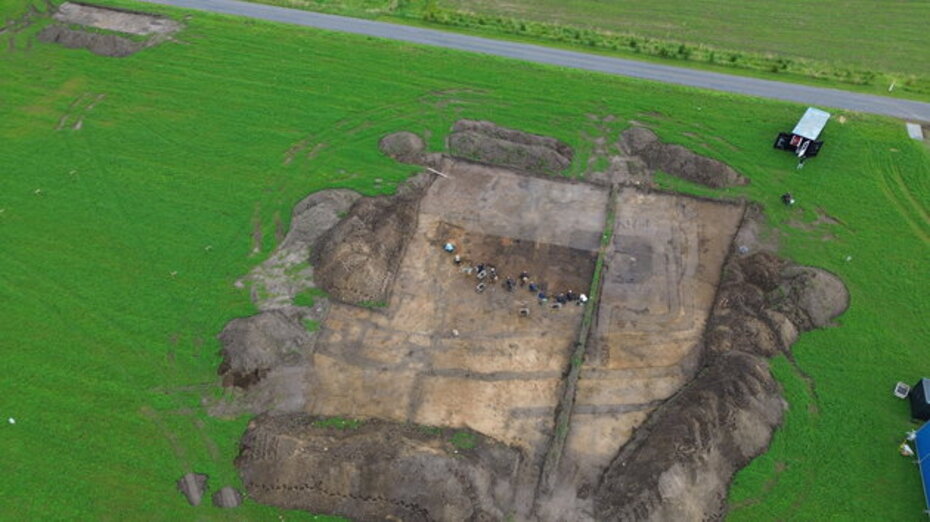
A 2,000-year-old Iron Age temple discovered in Denmark reveals a powerful fortified center with Roman, Celtic, and Mediterranean connections.
Archaeologists in Denmark have uncovered one of the most spectacular Iron Age discoveries in recent decades: a 2,000-year-old temple complex and fortified settlement hidden beneath a quiet grassland at Hedegård, near Ejstrupholm in central Jutland. The site is now considered one of the most important Iron Age power centers ever found in Denmark, offering rare insight into religion, politics, and long-distance connections during the transition from the late 1st century BCE to the early 1st century CE.
For nearly 25 years, archaeological work at Hedegård stood still. To the untrained eye, the area appeared to be nothing more than an idyllic meadow. But beneath the surface lay exceptionally well-preserved cultural layers that have survived almost untouched by modern farming — a coincidence that archaeologists now call a stroke of luck.
A Breakthrough After Decades of Silence
The first major discovery at Hedegård dates back to 1986, when archaeologist Orla Madsen uncovered an unusually rich Iron Age burial ground. The site contained an extraordinary number of weapon graves, immediately signaling high status and power. Excavations continued until 1993, after which research paused for decades due to changing priorities and personnel.
The site was never forgotten. In 2016, Museum Midtjylland resumed investigations, but the true breakthrough came in the summer of 2023. Archaeologists confirmed that the burial ground was only one part of a far larger complex: a large, enclosed settlement with workshops, elite residences, defensive structures, and a central religious building.
“Everything at Hedegård is bigger and wilder than usual,” said museum inspector Martin Winther Olesen in an interview with Dr.Dk. “When we talk about this site, nothing is ordinary.”
The Heart of an Iron Age Power Center
At the center of the settlement lies what archaeologists describe as its “heart”: a temple dating to around 0 AD (±50 years). This discovery is unprecedented in Denmark for this early period.
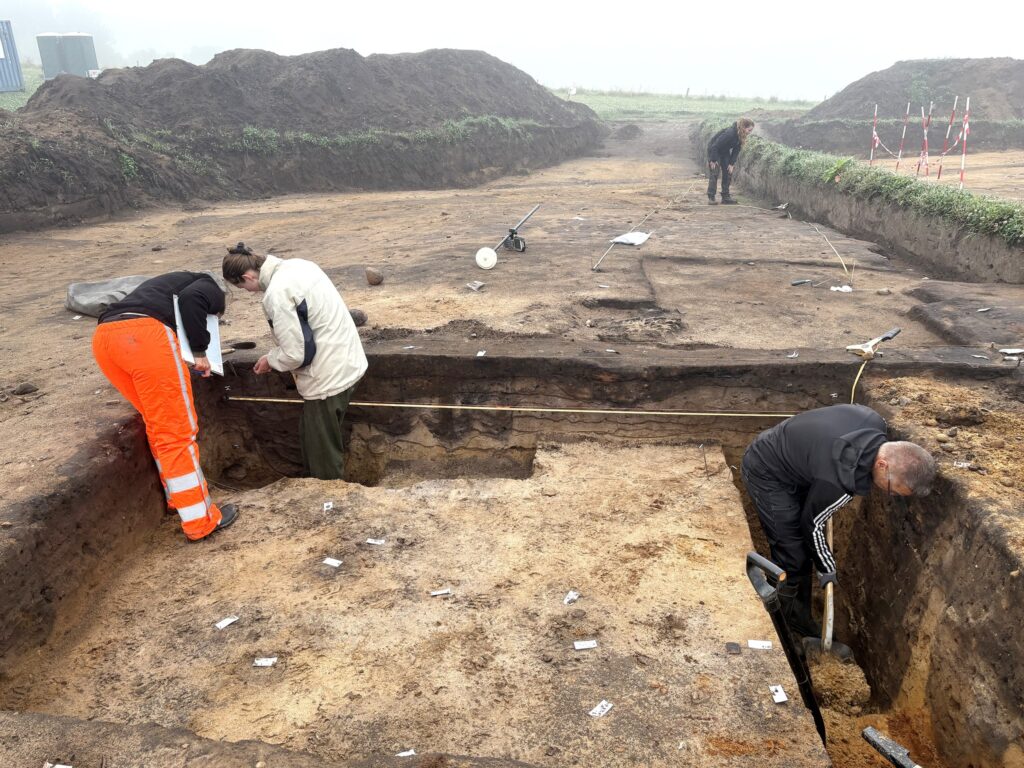
The temple was carefully examined in 2025 and revealed a nearly rectangular structure measuring approximately 15 x 16 meters. A ring of strong, round posts formed a covered colonnade around a smaller inner building. The inner structure had a southern entrance, deeply set support posts, and walls built from split planks and clay.
Inside, archaeologists identified a raised 2 x 2 meter central hearth, richly decorated with stamped and linear ornaments. The design suggests ritual use rather than domestic activity.
“This gives us our first real picture of what a religious building from this period looked like,” Olesen explained to Dr.Dk. “Until now, we only had examples that were several hundred years younger.”
Roman Threats and Local Power
The timing of the temple’s construction is significant. Around the turn of the millennium, the Roman Empire expanded northward into present-day Germany, reaching as far as the River Elbe — alarmingly close to Jutland.
Archaeologists believe the massive palisade and fortifications surrounding the temple and elite residence may have been a direct response to Roman military pressure.
“Suddenly, Roman expansion became a very real threat right on the doorstep,” Olesen told Dr.Dk. “How do you respond to that kind of pressure? Fortification may have been the answer.”
The defensive structures were built following Roman-inspired architectural principles, highlighting not only awareness of Roman power but also technical knowledge and strategic planning.
Global Connections in the Iron Age
Among the most remarkable finds inside the burned remains of the temple were two rare glass beads, left behind after the building was deliberately cleared and destroyed by fire — likely as part of a ritual closure.
Glass beads are extremely rare in early Iron Age Scandinavia. One turquoise-blue bead, approximately 4 cm long, likely originated in Egypt. The other, a delicate gold-foil bead, was traced to the Levant in the eastern Mediterranean.
These artifacts demonstrate that Hedegård was not an isolated northern settlement but part of long-distance trade and cultural networks stretching thousands of kilometers.
“Through Hedegård, we now see direct connections from Jutland to the Mediterranean world,” researchers noted.
Craftsmanship, Wealth, and Authority
Within the fortified settlement, archaeologists identified workshops for gold, bronze, iron, and amber craftsmanship, as well as weapon production. Combined with the elite residence and religious center, the evidence points to Hedegård as a hub of political authority, ritual power, and economic strength during the Early Iron Age.
This combination is extremely rare and elevates Hedegård to a status comparable with major power centers in Central Europe.

Preserved for the Future
Recognizing the site’s importance, Denmark’s Agency for Culture and Palaces purchased the land in December 2024. Agricultural activity has now been permanently banned to ensure long-term preservation.
“I am extremely relieved,” Olesen said to Dr.Dk. “Now it is secured for future generations.”
The Hedegård project is a collaboration between Museum Midtjylland, Moesgaard Museum, Museum Horsens, Danish authorities, universities, and international researchers. Like the ancient site itself, the project connects local discovery with national and global research efforts.
Redefining Denmark’s Iron Age
The discovery at Hedegård fundamentally reshapes our understanding of the Danish Iron Age. It reveals a society that was religiously organized, militarily prepared, economically advanced, and internationally connected at a much earlier stage than previously believed.
As excavations continue, Hedegård promises to remain a key archaeological site — not only for Denmark, but for all of Northern Europe.
Cover Image Credit: Drone image of the Iron Age temple during excavation and surface cleaning at Hedegård. Museum Midtjylland.
